The prototype chain is one of the core JS basics. After reading many articles, it is better to summarize it myself to reinforce understanding.
Key keywords: prototype, proto, constructor, new.
If there are mistakes, please correct me.
prototypeis a property on functions.__proto__is a property on objects.constructoris a property on objects.An instance’s
__proto__points to the prototype object that created it. The instance prototype’sconstructorpoints to the constructor function. The instance prototype’s__proto__points to the next level up. If there is no other prototype, it is Object’s instance prototype.See the diagram below (from the web).
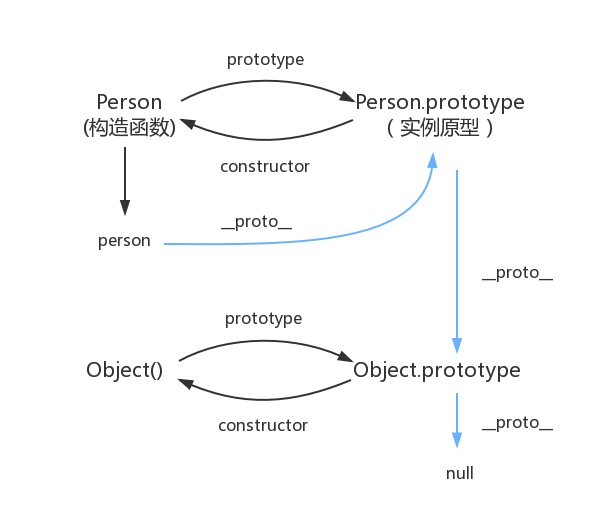
- The constructor exists in two places: the constructor in ES6 class syntax, and the object’s constructor property. ES6 class is just syntax sugar; the underlying mechanism is still the prototype chain. So the constructor is the function that creates the instance.
- The prototype chain refers to the chain of objects in inheritance, not functions.
Benefits of the prototype chain
It is a flexible inheritance model compared to class inheritance. For example, B.prototype = new A() allows instances of B to access A’s methods.
Quiz
Here are some questions to test understanding.
Q1
function Fn(){
    var a = 12
    this.getName = function(){
        console.log('private getName')
    }
}

Fn.prototype.getName = function (){
      console.log('public getName')
}

var fn = new Fn()
var fn1 = new Fn()
// 1, 2
console.log(fn.a)
console.log(fn.getName())
// 3, 4, 5
console.log(fn.getName === fn1.getName)
console.log(fn.__proto__.getName === fn1.__proto__.getName)
console.log(fn.__proto__.getName === Fn.prototype.getName)
// 6, 7
console.log(fn.hasOwnProperty === Object.prototype.hasOwnProperty)
console.log(fn.constructor === Fn)
/* Output
*   undefined
*   private getName
*   false
*   true
*   true
*   true
*   true
*/
Q2
function P() {}
var p1 = new P();
P.prototype.age = 18;
P.prototype = {
  constructor: P,
  name: 'zz'
};
P.prototype.num = 20;
P.prototype.age = 20;
console.log(p1.name);
console.log(p1.age, 'dd');
console.log(p1.num);
var p2 = new P();
console.log(p2.name);
/**
 * Output
 * undefined
 * 18 dd
 * undefined
 * zz
 */
Q3
function test() {}
console.log(test.prototype.constructor.constructor);
/**
 * Output
 * [Function: Function]
 */
Final Thoughts
Understanding these basic concepts is the foundation of writing good code.